

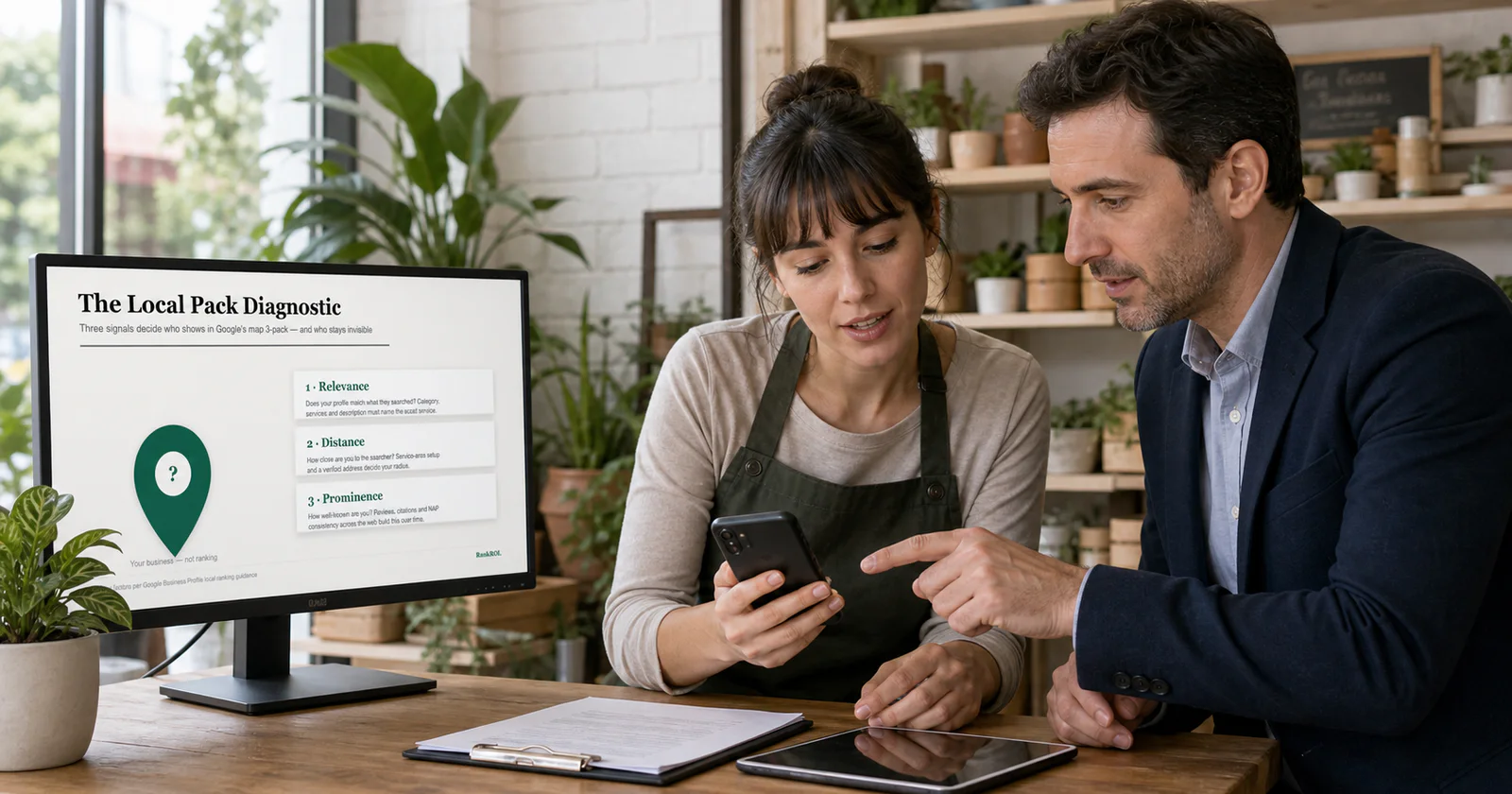
For any business that serves a place — a clinic, a law firm, a plumber, a salon — local search is the potentially high-value valuable channel there is. The people finding you on Google Maps are ready to book. Winning that visibility comes down to three reinforcing pillars: consistent NAP, a steady flow of reviews, and a fully optimized Google Business Profile. Get all three right and you dominate the local pack.
Pillar 1 — NAP consistency
NAP stands for Name, Address, and Phone number. Google builds confidence in your business by seeing the exact same details across your website, Google Business Profile, directories, and social profiles. Every inconsistency — an old suite number, a tracking phone number, an abbreviated street — chips away at that confidence and at your ranking.
Pick one canonical format for your name, address, and phone, and use it verbatim everywhere. Add Organization/LocalBusiness schema so machines read it unambiguously.
Pillar 2 — Reviews
Reviews are the clearest trust signal in local search — for both Google and the customer deciding whether to call. What matters is not just star rating but recency, volume, and responses. A steady stream of recent reviews beats a pile of old five-stars, and replying to every review (good or bad) signals an active, accountable business.
- Ask through the same neutral follow-up offered to every eligible customer. Right after a successful job is when customers are most willing.
- Make it one tap. Send a direct review link by text or email; don't make people search.
- Respond to every review. Thank the good ones; address the bad ones calmly and publicly.
- Keep it steady. A consistent trickle looks more authentic than a sudden burst.
Never buy or fake reviews — platforms detect and penalize it, and it destroys the trust the whole strategy depends on. Chart figures below are illustrative.
Pillar 3 — Google Business Profile
Your Google Business Profile is your real local homepage. A complete, active profile — correct categories, services, hours, photos, and regular posts — outranks a neglected one. Treat it like a living asset: update photos, answer questions, post offers, and keep every field filled.
How to measure local visibility
Track three things monthly: your ranking in the local pack for your core "service + city" terms, the calls and direction requests reported in your Business Profile insights, and your review velocity (new reviews per month). Movement in the pack usually follows improvements in the other two.
Failure cases
- Stale NAP. An old address on one directory can quietly suppress rankings everywhere.
- Review droughts. A long gap in feedback may reduce the amount of recent information available to customers, but it is not a documented 'fading business' ranking signal.
- Ignoring negative reviews. An unanswered one-star does more damage than the rating itself.
- Set-and-forget profile. Empty fields and old photos lose to competitors who stay active.
Where to go next
Local trust and E-E-A-T are the same muscle. Pair this with E-E-A-T as a business asset and turn local visibility into booked jobs with the Blog ROI framework. Want a local visibility audit? Request one free.

Reader discussion
No approved comments yet.