
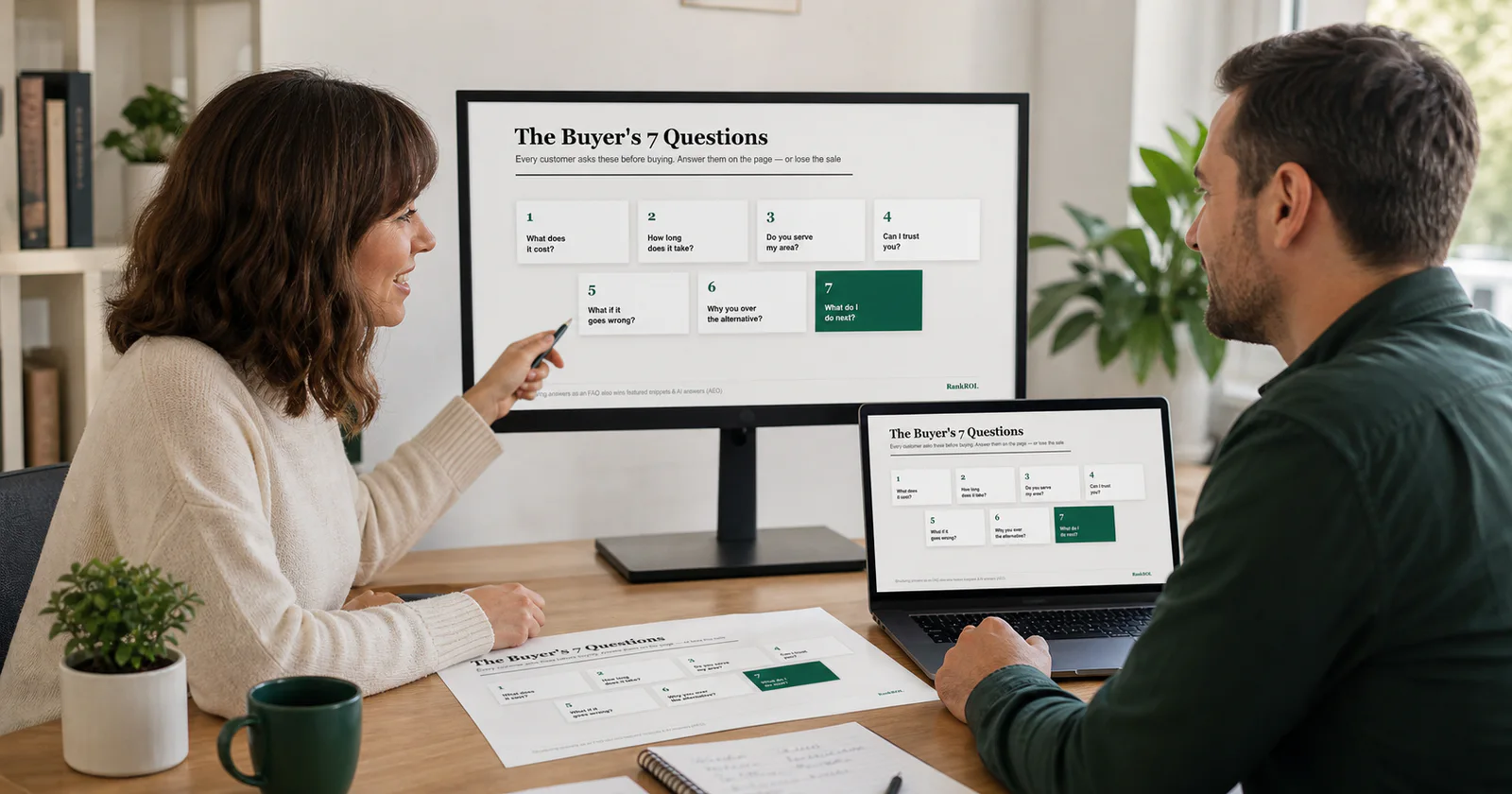
A visitor lands on your website ready to spend money. Sixty seconds later they leave and buy from someone else — not because your competitor is better, but because their website answered the questions yours left hanging. Every customer arrives with the same short list of questions running through their head. Answer them clearly and you win the sale; leave them guessing and you lose it. Here are the seven questions, and how answering them also makes you the answer that search engines and AI assistants pick.
Here is the trap most business websites fall into: they are written from the inside out, describing the company, its history and its values, when buyers do not care about any of that yet. Buyers care about their own questions, and they are silently scoring your page against them in the first few seconds. A page organised around the company loses to a page organised around the customer's questions every single time — not because it is less polished, but because it makes the visitor do the work of finding what they need. Flip the page to answer their questions first, and the same traffic suddenly starts converting.
The seven questions every buyer is asking
Whether they say it out loud or not, this is the checklist running in a buyer's mind on your page. Score your own website honestly: does it answer each one clearly, above the fold or within a click?
1. What does it cost?
The question owners most want to dodge is the one buyers most want answered. You do not need an exact price, but "contact us for pricing" as the only answer sends people to a competitor who gave them a range. Offer a starting price, a typical range, or "projects usually run between X and Y" — anything that lets them self-qualify.
2. How long does it take?
Timeline is a top anxiety. A roofer who says "most repairs are completed within 48 hours" removes uncertainty a silent competitor leaves hanging. State typical turnaround plainly.
3. Do you serve my area?
Nothing kills momentum like a visitor unsure whether you even cover them. List your service areas explicitly — the towns, regions or radius. This overlaps directly with your local visibility: the same clarity that helps customers helps Google place you.
4. Can I trust you?
Buyers scan for proof you are a real, competent business: reviews, real photos, named people, credentials, a physical address. This is the E-E-A-T trust kit we detailed in E-E-A-T as a business asset — it convinces the human and the algorithm at once.
5. What if it goes wrong?
Guarantees, warranties and return policies remove the fear of a bad decision. "Backed by a 12-month guarantee" or "not happy? we will make it right" does more heavy lifting than any amount of persuasive copy, because it shifts the risk off the buyer.
6. Why you over the alternative?
Buyers are comparing. If your page does not state what makes you the better choice, they invent their own criteria — usually price. Name your genuine differentiator plainly: faster, local, specialised, guaranteed, more experienced.
7. What do I do next?
Even a convinced buyer needs a clear, single next step. One obvious call to action — call, book, request a quote — told plainly and repeated. Ambiguity here undoes all the trust you just built, the same leak we covered in why websites get traffic but no customers.
The fastest way to add these answers without redesigning anything is an FAQ section on every service page. It slots the seven answers in one place — and it is exactly the format that wins featured snippets and AI answers.
Why answering these wins search and AI too
Here is the compounding benefit: the questions your customers ask are the exact questions they type into Google and into ChatGPT. When you answer them clearly and mark them up as an FAQ, you become eligible for featured snippets and People Also Ask boxes — and you become the source AI assistants quote. This is Answer Engine Optimization: the same work that convinces a human on your page convinces the machine deciding who to recommend.
Where to place each answer on the page
Having the answers is not enough; buyers scan rather than read, so placement decides whether they ever see them. Match each question to where the eye lands:
- Above the fold: your differentiator (question 6) and the next step (question 7). These are the first things a scanning visitor needs.
- In the body: cost, timeline and service area (questions 1–3), woven into the description of what you do rather than buried on a separate page.
- Near the call to action: trust signals and guarantees (questions 4–5), because they are exactly what a hesitating buyer needs at the moment of deciding.
A visitor should be able to answer all seven in under thirty seconds of skimming. If finding any answer requires clicking to another page or reading a wall of text, assume most people will not bother — they will leave to a competitor who made it effortless.
Do the ten-second test: open your service page, glance for five seconds, and look away. Could you state the price range, the next step and one reason to choose this business? If not, neither can a real visitor — and neither can an AI trying to summarise you.
Your action step
- Open your main service page and score it against all seven questions.
- Find the gaps — usually price, timeline and guarantees are missing.
- Add an FAQ section answering each in 40–60 clear words.
- Mark it up as reader-focused FAQ content so search and AI can read it.
Your website has one job: turn a curious visitor into a confident buyer. It does that by answering the seven questions before the visitor has to ask. Do that, and you stop losing sales you had already half-won — and you start showing up as the answer everywhere your customers look.

Reader discussion
No approved comments yet.