
A cleaning business sells something uniquely intimate: access to someone's home or workplace when they are not there. That makes trust the entire product. A customer is not really buying clean floors — they are buying the confidence to hand a stranger a key. The cleaning companies that grow understand this and lead with proof: vetted staff, real reviews, insurance, and a professional presence that makes a cautious customer feel safe. And the smartest ones build their business on recurring contracts, not one-off cleans. This is the complete marketing playbook for cleaning services.
What makes cleaning different from almost every other local service is the intimacy of it. You are not fixing a car in a shop or meeting a client at an office — you are inside their home, often when they are not there, handling their belongings and holding a key. That intimacy is why price matters so much less than owners assume and why trust matters so much more. Get the trust signals right and you are not competing on being cheapest; you are competing on being the company a cautious person feels genuinely safe letting in, which is a far better place to compete.
How people actually choose a cleaner
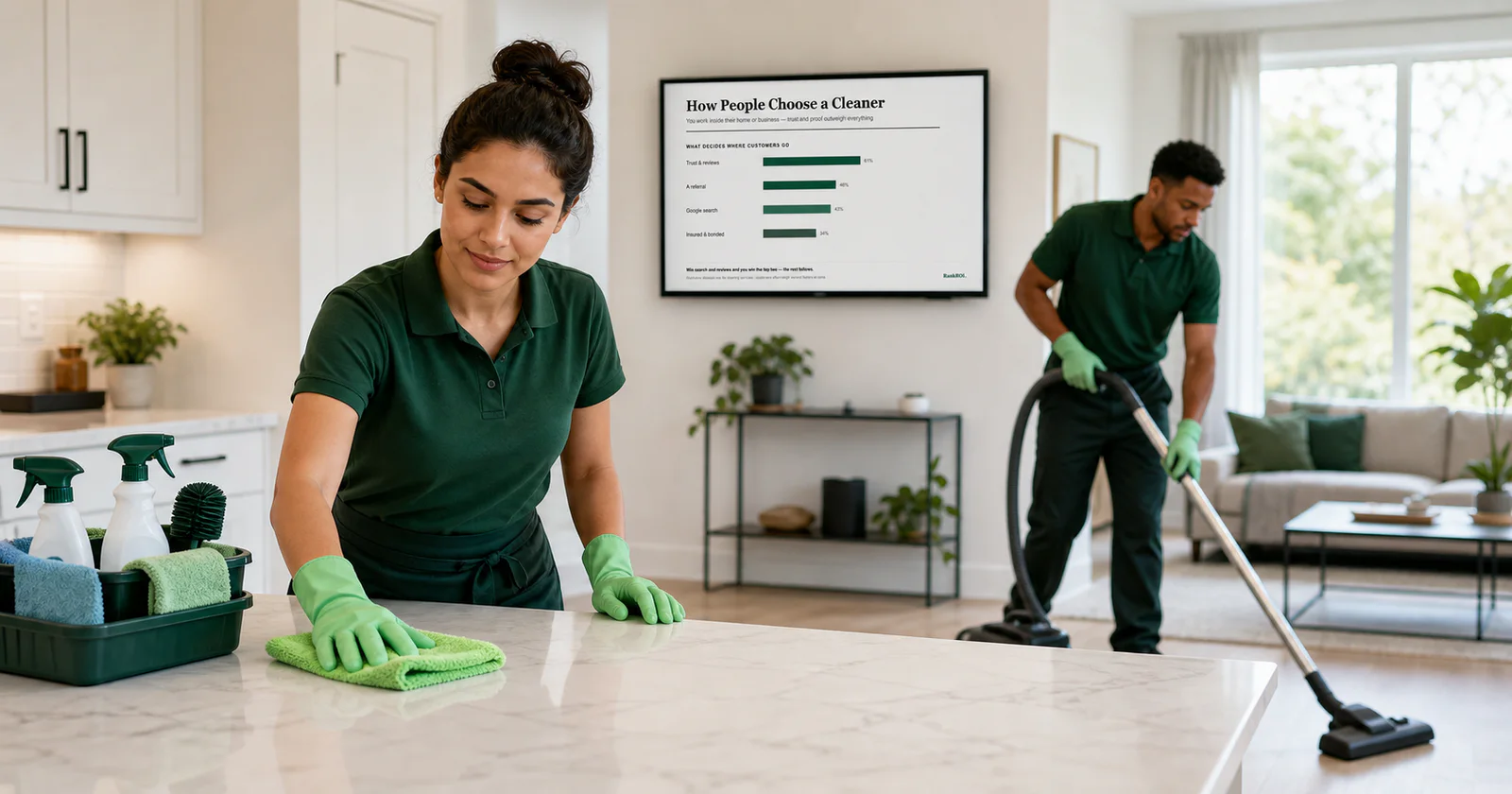
Because trust dominates, the cleaning decision leans heavily on reviews and reassurance. Here is the mix that decides who gets the key.
- Trust: vetting, insurance and a professional team reduce the risk of letting someone into a home or workplace.
- Proof: detailed reviews and real team photos make those claims believable.
- Fit: clear services, availability and recurring-plan options make the final choice easy.
Lead with trust, everywhere
Every part of your marketing should answer the customer's real question: can I trust these people in my home? Show that your staff are background-checked, that you are insured and bonded, and put real reviews front and centre. Photos of your actual team in uniform reassure more than any stock image. This is E-E-A-T applied to a business where trust is literally the service — see E-E-A-T is a business asset.
Put your vetting process in plain language on your site: "every cleaner is background-checked, insured and trained." Customers rarely see this stated, so saying it clearly sets you apart instantly and removes the exact fear that stops them booking.
Get found when someone searches
Cleaning jobs often start with "house cleaning near me" or "office cleaning [city]." Ranking in the Google Maps pack and local results puts you in front of people ready to book. Getting there comes down to relevance, distance and prominence — the diagnostic is in why your business does not show up on Google Maps. Separate your residential and commercial pages, since these are different customers searching different terms.
Reviews are your reference check
For an in-home service, reviews are everything — a company with 150 reviews describing reliable, trustworthy, thorough cleaners wins over an unknown when other factors align. Ask every customer for a review after a great clean, and reply to all of them; how you handle a complaint about a missed spot tells future customers how you would treat their home. The review response playbook shows the formula.
The money mechanic: recurring contracts, not one-off cleans
A one-time clean is a transaction; a weekly or fortnightly contract is a business. Recurring customers give you predictable revenue, easier scheduling, and dramatically higher lifetime value.
Pitch a recurring schedule at the first clean, when the customer is delighted with the result — and make booking one effortless online. Your website should answer the trust, pricing and scheduling questions up front, the same principle as the 7 questions customers ask before buying, so a cautious customer can go from unsure to booked without a nervous phone call.
What most cleaning companies get wrong
The most common mistake is competing on price in a business where trust, not cost, is what customers are actually buying. Racing to be the cheapest attracts one-off, price-sensitive customers who cancel the moment a competitor undercuts you, and it quietly signals that you are a commodity rather than a trusted professional you would hand a key to. The companies that build stable, profitable books lead with vetting, insurance and reliability, and charge accordingly — because a customer who chose you for trust stays for years, while one who chose you for a discount is already shopping for the next one.
The second mistake is failing to state, in plain words, the very things that would win the cautious customer. Owners assume it is obvious that their staff are background-checked and the business is insured, so they never say it — and the nervous first-time customer, who is imagining a stranger alone in their home, clicks away to a company that did spell it out. The reassurance that closes the booking is often information you already have and simply forgot to put on the page.
A recurring customer is worth dozens of one-off cleans, so every first clean should end with an offer of a regular schedule. The moment the customer is standing in a spotless home, delighted, is the easiest time you will ever have to convert them into weekly or fortnightly recurring revenue.
The cleaning service visibility checklist
- Lead with trust — vetting, insurance and bonding stated plainly on every page.
- Complete your Google Business Profile with service areas and real team photos.
- Separate residential and commercial pages for their different searches.
- Ask for a review after every great clean and reply to all of them.
- Pitch a recurring schedule at the first clean to build steady revenue.
- Make booking effortless online so cautious customers can commit without a call.
In cleaning, trust is the product and recurring contracts are the business. Prove you are safe to let in, get found when someone searches, and turn every one-off clean into a standing appointment. If you would rather have that system built for you, that is exactly what a free growth audit is designed to map out.



Reader discussion
No approved comments yet.