
For a contractor, one job can be worth what a salon earns in a month — which means marketing works completely differently. You are not chasing volume; you are chasing a handful of high-value projects from homeowners who are nervous about handing tens of thousands of dollars to someone they found online. Trust and proof are everything. The contractors who stay booked are not the cheapest or the loudest; they are the ones whose reviews, portfolio and responsiveness make a cautious homeowner feel safe choosing them. This is the complete marketing playbook for construction companies and contractors.
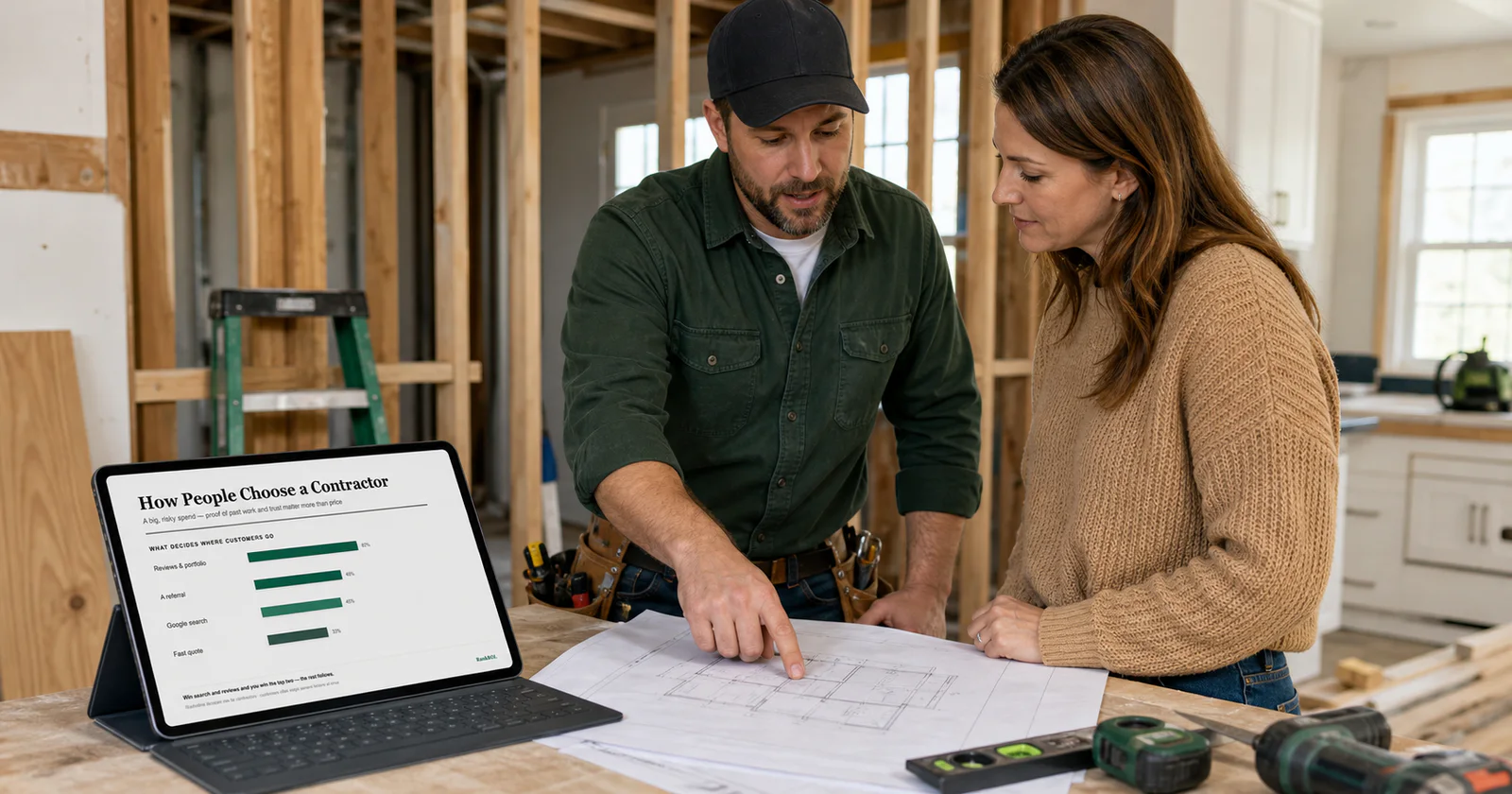
How people actually choose a contractor
A construction decision is slow, high-stakes and reference-driven. Homeowners research heavily, ask around, and shortlist based on proof before they ever request a quote. Here is the mix that decides it.
- Relevant proof: homeowners want to see completed projects similar to their own.
- Reputation: references, reviews, licensing and insurance lower the risk of a high-value decision.
- Process: a clear scope, responsive follow-up and realistic timeline often decide which qualified contractor wins.
Your portfolio is your best salesperson
Homeowners cannot judge your craftsmanship in advance, so they judge your past work instead. A website with detailed project galleries — before, during and after, with the scope and location — does more to win a bid than any amount of marketing copy. Organize projects by type (kitchens, extensions, commercial fit-outs) so the homeowner sees you have done their job before. Those project pages also rank for searches like "kitchen remodel [city]," bringing in exactly the homeowner looking for that work.
Photograph every job, even small ones, and turn each into a short case study: the problem, what you did, the result. This is the E-E-A-T "show your work" principle in action — it builds the trust that closes bids and the content that ranks. See E-E-A-T is a business asset.
Get found when the project starts as a search
Many projects begin with a search — "extension builder near me," "commercial contractor [city]." Ranking in the Google Maps pack and the local results puts you in front of homeowners with a live project and a budget. Getting there comes down to relevance, distance and prominence; the diagnostic is in why your business does not show up on Google Maps.
Reviews are your reference check, done in advance
Before choosing a contractor, homeowners essentially want a reference — and reviews are that reference, available before they call. A builder with 80 detailed reviews describing on-time, on-budget projects may be more persuasive than an unknown quote. Ask every eligible client for a review at handover, through the same neutral, non-pressured workflow, and respond to all of them. The review response playbook matters especially here, where one unaddressed complaint can cost a five-figure job.
The money mechanic: speed and follow-up on quotes
In construction, leads are scarce and valuable, so how you handle each one decides your revenue. The contractor who responds fast and follows up wins jobs the one who lets enquiries sit loses.
Your website's job is to make requesting a quote effortless and to answer the questions a nervous homeowner has — timeline, process, guarantees, insurance. That is the same principle as the 7 questions customers ask before buying, and if your site sends enquiries into a slow or leaky funnel you are wasting hard-won leads, as covered in why websites get traffic but no customers.
What most contractors get wrong
The number one mistake contractors make is being slow to respond to enquiries. A homeowner who fills in your quote form is often messaging three or four builders at once, and the research is consistent across trades: the one who replies first and fastest wins a hugely disproportionate share of the jobs. Contractors who let enquiries sit for two days because they were on site are effectively handing those projects to a competitor who picked up the phone. If you do nothing else, build a habit or a system that gets every inquiry a same-day response.
The second mistake is having no portfolio, or a portfolio hidden in a Facebook album nobody sees. Your past work is the potentially high-value persuasive thing you own, and it needs to live on your website, organized by project type, where it both convinces homeowners and ranks in search. Contractors routinely do beautiful work and then never photograph it, throwing away the exact proof that would win their next ten bids. Every finished job is a marketing asset; treat it like one.
Cheap leads are often the most expensive. Chasing the lowest-price enquiries fills your schedule with difficult, low-margin jobs and price-shoppers who will leave for a cheaper quote. Position on trust and proof instead, and you attract homeowners who choose you for quality and pay accordingly.
The contractor visibility checklist
- Build project pages by type with before/after photos, scope and location.
- Complete your Google Business Profile with precise categories and service areas.
- Ask for a review at every handover and reply to all of them.
- Make requesting a quote effortless and answer timeline, insurance and guarantee questions.
- Respond to every inquiry fast and follow up two or three times.
- Track cost per lead so you know which marketing actually pays.
One good project pays for a year of doing this right. Build the proof that makes a cautious homeowner feel safe, get found when their project starts as a search, and handle every lead like the five-figure opportunity it is. If you would rather have that system built for you, that is exactly what a free growth audit is designed to map out.



Reader discussion
No approved comments yet.