
Roofing marketing has a split personality. Half your jobs are emergencies — a leak, a storm, a homeowner in a panic searching at 7am. The other half are planned replacements worth many thousands of dollars, chosen slowly and carefully. Winning both means being impossible to miss when someone needs a roofer now, and impossible to distrust when someone is weighing a major investment. The roofers who dominate their market have built exactly that: instant visibility for the urgent searches and deep trust for the big-ticket ones. This is the complete marketing playbook for roofing companies.
What makes roofing marketing worth getting right is the sheer value of a single job. Where a local shop might need dozens of customers to make a good month, a roofer can make one from a handful of replacements — which means every improvement in your visibility and trust translates directly into serious revenue. Get findable in the urgent moment and credible for the big decision, and you are not chasing volume; you are capturing a small number of high-value jobs that most of your competitors never even knew were searching.
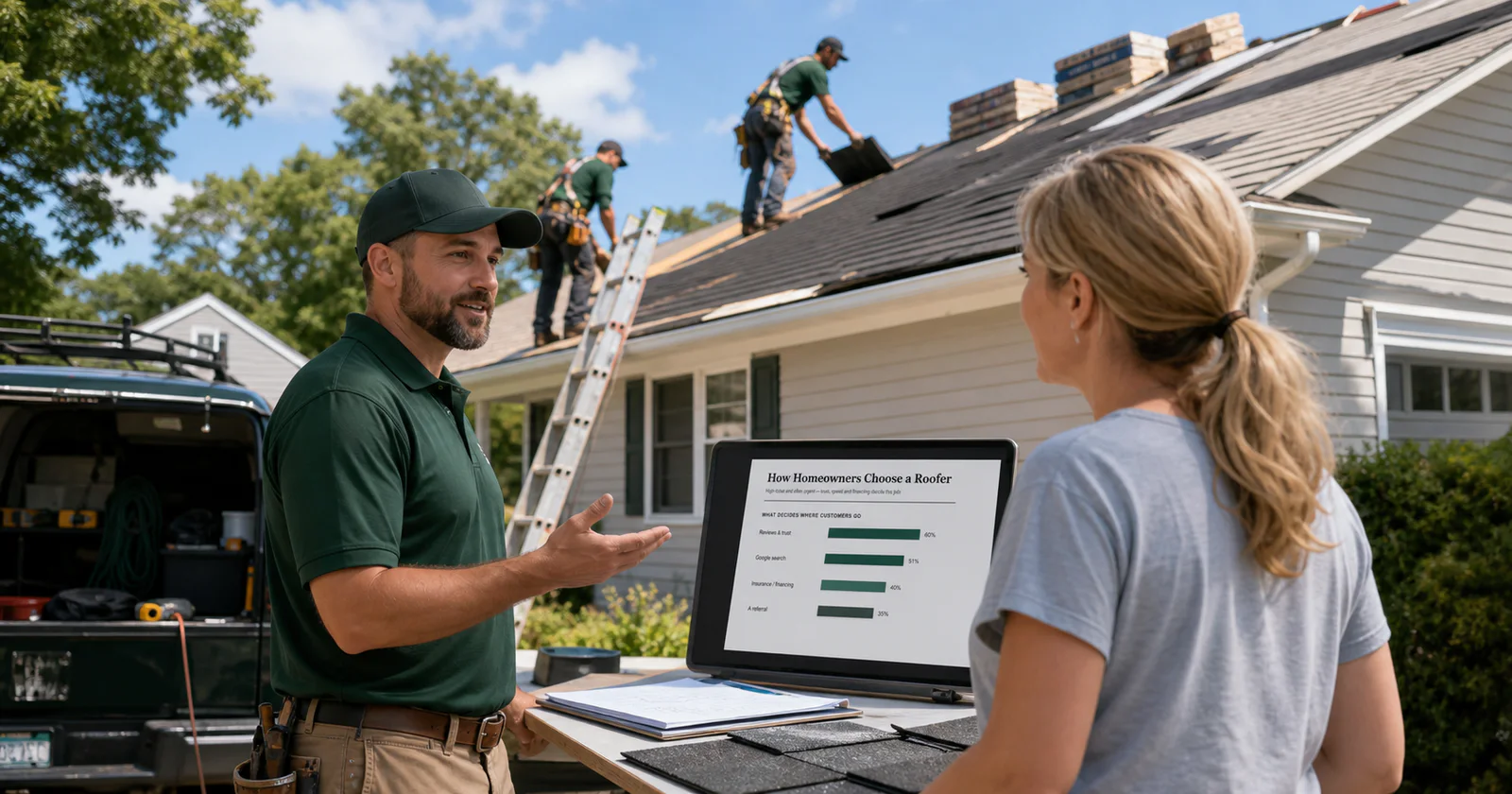
How homeowners actually choose a roofer
Whether it is an emergency or a planned replacement, the decision leans on trust and findability. Here is the mix that decides who gets the job.
- Immediate availability: urgent repair searches reward the first credible company that responds.
- Proof and protection: local projects, reviews, licensing, insurance and warranties reduce high-ticket risk.
- A workable offer: a clear inspection, scope, timeline and financing explanation help the homeowner say yes.
Own the emergency search
When a homeowner has water coming through the ceiling, they search "emergency roof repair near me" and call one of the first businesses they see. If you are not in the Google Maps pack for that search, you never get the call — and emergency jobs often turn into full replacements. Ranking there comes down to relevance, distance and prominence; the diagnostic is in why your business does not show up on Google Maps. Make sure your profile makes emergency availability obvious.
Create separate pages for your separate jobs — "roof repair," "roof replacement," "storm damage," "gutter repair." Each ranks for its own searches and lets you speak directly to that homeowner's situation, whether they are panicking about a leak or planning a considered replacement.
Trust is what closes the big-ticket job
A roof replacement is one of the largest home expenses a family faces, so the planned-replacement customer is doing serious homework. Reviews, licensing and insurance shown clearly, warranty details, and real photos of completed roofs are what convert that research into a signed contract. This is E-E-A-T applied to a high-ticket trade — see E-E-A-T is a business asset. A roofer with 150 detailed reviews and a portfolio of local roofs wins over a cheaper unknown, because the homeowner is buying peace of mind as much as a roof.
Reviews are your reputation when it matters most
Ask every customer for a review at completion, when the new roof is on and they are relieved and happy. Respond to all of them — the storm-chaser scams in this industry make homeowners wary, so a long trail of genuine, well-handled reviews is a powerful differentiator. The review response playbook shows how to handle the occasional difficult one.
The money mechanic: make the big number easy to say yes to
The barrier on a roof replacement is rarely desire — it is cost. Roofers who make financing and insurance clear close far more jobs.
Your website should make requesting an inspection or quote effortless and answer the cost, timeline and warranty questions up front, the same principle as the 7 questions customers ask before buying. Respond fast — for both emergencies and planned jobs, the first credible roofer to reply is often the one who wins.
What most roofers get wrong
The biggest mistake in roofing is relying on storm-chasing and door-knocking while building no lasting online presence. Those tactics can fill a season, but they leave you starting from zero every year and lumped in with the fly-by-night operators homeowners have learned to distrust. The roofers who build a durable, profitable business invest in the assets that compound — reviews, local rankings, a portfolio — so that when the next storm hits, they are the established, trusted name that shows up first, not another unknown truck in the neighborhood.
The second mistake is competing on price for a decision that is really about trust. A roof is one of the largest expenses a homeowner faces, and the ones who choose purely on the lowest bid are exactly the customers most likely to have problems and leave bad reviews. When you lead with proof, licensing, warranty and reviews, you attract homeowners who understand that a cheap roof done badly is the most expensive roof of all — and who happily pay for peace of mind.
An emergency call is not just a repair; it is an audition. The homeowner with a leak today is often the same homeowner who needs a full replacement next year, and how you handle the urgent fix decides whether you win the big job. Treat every small emergency as the start of a much larger relationship.
The roofing visibility checklist
- Build pages per job type — repair, replacement, storm damage, gutters.
- Complete your Google Business Profile with service areas and emergency availability.
- Show licensing, insurance and warranty clearly on the site.
- Ask for a review at every completion and reply to all of them.
- Make financing and insurance help obvious to remove the cost barrier.
- Respond to every lead fast — speed wins both emergencies and big jobs.
Roofing rewards the company that is there in the emergency and trusted for the big decision. Be findable the instant a homeowner needs you, build the reviews and proof that make a major investment feel safe, and make the number easy to say yes to. If you would rather have that built for you, that is exactly what a free growth audit maps out.



Reader discussion
No approved comments yet.