
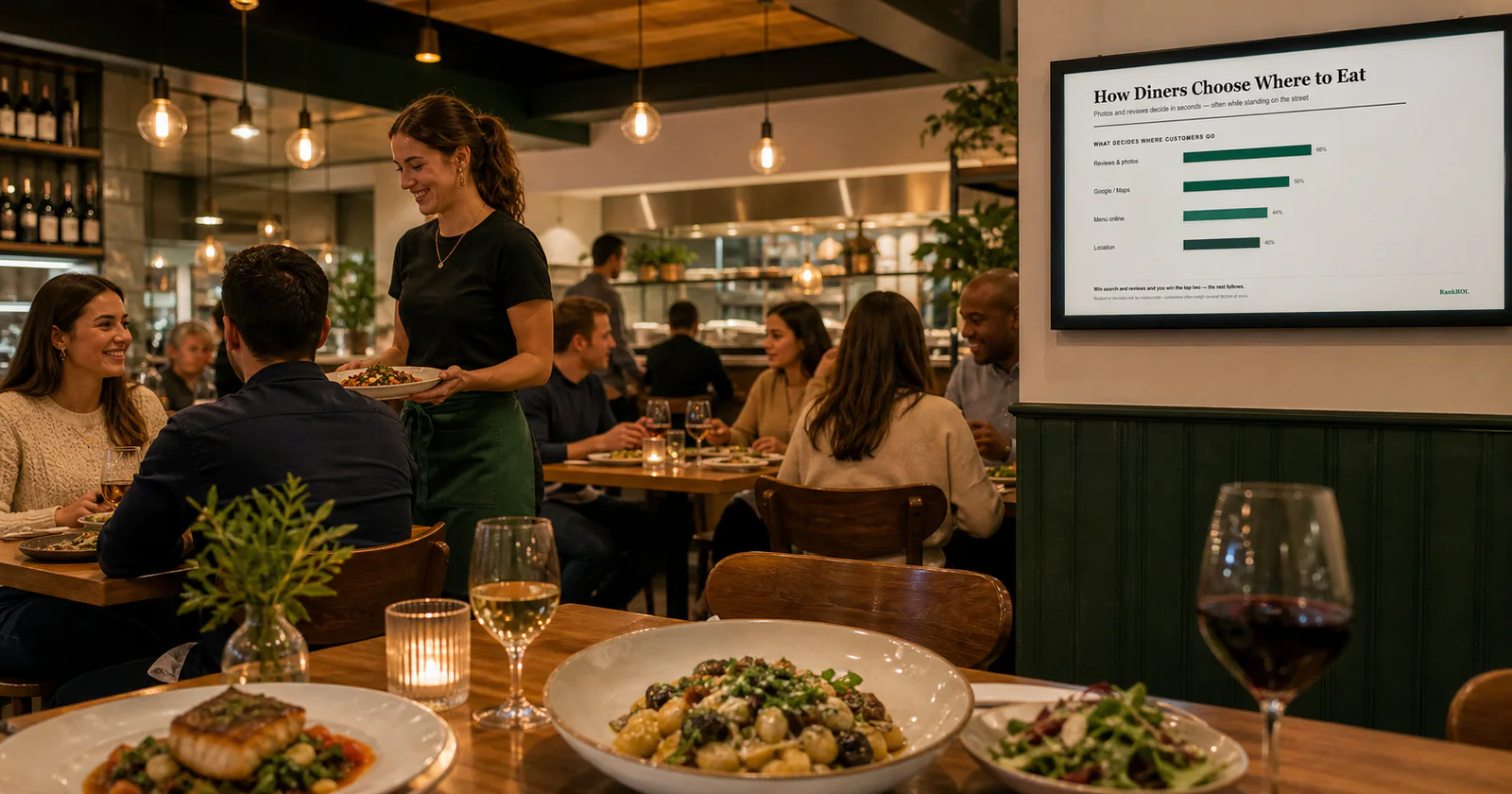
A restaurant lives or dies on a decision made in seconds, often by someone standing on the street or sitting in a car deciding where to eat right now. They pull out their phone, glance at photos and a star rating, and pick. That instant, visual, review-driven choice is what makes restaurant marketing unlike any other local business — and it is why a restaurant with mediocre food and great photos often beats a great kitchen nobody can find. The restaurants that stay full have mastered the moment of the hungry search. This is the complete marketing playbook for restaurants and cafés.
How diners actually choose where to eat
The restaurant decision is quick, hunger-driven and made on a phone. Photos and reviews do almost all the persuading. Here is the mix.
- Appetite: fresh photos and a readable menu create the initial desire to visit.
- Confidence: recent reviews, accurate hours and clear dietary information reduce uncertainty.
- Convenience: distance, availability and one-tap booking or ordering turn intent into a table or order.
Own the "restaurants near me" moment
When someone searches "restaurants near me" or "brunch [area]," Google shows a map of options with photos and ratings, and the hungry diner picks fast. Being in that pack with great photos is close to an important part of the decision. Ranking there comes down to relevance, distance and prominence, covered in why your business does not show up on Google Maps. Your Google Business Profile is your most important marketing asset — more than your website — because it is where the decision actually happens.
Fill your Google Business Profile with mouth-watering, professional-quality photos of your actual dishes, and keep them fresh. On a hungry search, the restaurant with the most appetising photos wins the table — this is the single highest-return thing a restaurant can do, and it costs almost nothing.
Reviews and photos are the decision
Diners trust other diners. A restaurant with 400 recent reviews at 4.6 stars and hundreds of appetising photos wins over an unknown, when other factors align. Make it easy and natural to leave a review — a line on the receipt, a friendly ask, a table card — and respond to reviews, because diners read how you handle criticism. The review response playbook shows how to turn a complaint into a display of hospitality.
Make the menu and booking effortless
Two things a hungry or planning diner needs instantly: to see your menu and to book or order. A menu buried in a slow PDF, or no obvious way to reserve, loses customers who were ready. Put your menu on the page as fast-loading text, make reservations or online ordering one tap, and ensure it all works flawlessly on a phone — where nearly every restaurant decision happens. A slow site loses the table, as covered in the speed guide, and burying key answers is the leak in the 7 questions customers ask before buying.
The money mechanic: turn first-timers into regulars
A restaurant's profit lives in repeat visits. A first-timer who becomes a weekly regular is worth a hundred times a one-off, so the smartest restaurants build ways to bring people back.
Collect diner contact details through bookings, ordering or a loyalty offer, and stay in touch with specials and events — a message to past diners is the cheapest way to fill a quiet Tuesday. Keep your social feed active with the same appetising photos that win the search.
What most restaurants get wrong
The biggest mistake restaurants make is pouring energy into a website while neglecting the Google Business Profile where the decision actually happens. When a hungry person searches "restaurants near me," they choose from the map — photos, rating, hours — often without ever visiting a website at all. A restaurant with a beautiful site but a thin, photo-less Google profile is invisible at the exact moment of choice, losing tables to a lesser kitchen that simply had more appetising photos in the place people were looking.
The second mistake is letting reviews and photos go stale. A rating built two years ago and a handful of dim photos do not reflect the restaurant you run today, and diners can tell — recent, fresh, mouth-watering images and a steady stream of new reviews signal a place that is alive and worth visiting. Restaurants that treat their Google presence as set-and-forget slowly fade in the rankings and the appetite of searchers, while those that keep it fresh stay at the top of the hungry search.
Your food is the most photogenic asset you own, and every plate is a potential ad. Professional-quality photos of your actual dishes, kept fresh on your Google profile and social feeds, do more to fill tables than any promotion — because on a hungry search, the most appetising photo wins, every single time.
The restaurant visibility checklist
- Fill your Google Business Profile with fresh, professional dish photos — your top priority.
- Keep hours and details perfectly accurate so no hungry diner is turned away.
- Make reviews easy to leave and respond to all of them.
- Put your menu on the page as fast text and make booking or ordering one tap.
- Capture diner details and bring people back with specials and events.
- Keep social active with the photos that win the hungry search.
Restaurants are won and lost in the seconds a hungry person spends on their phone. Win that moment with irresistible photos and glowing reviews, make the menu and booking effortless, and turn first-timers into regulars, and the tables stay full. If you would rather have that system built for you, that is exactly what a free growth audit is designed to map out.
Reader discussion
No approved comments yet.